
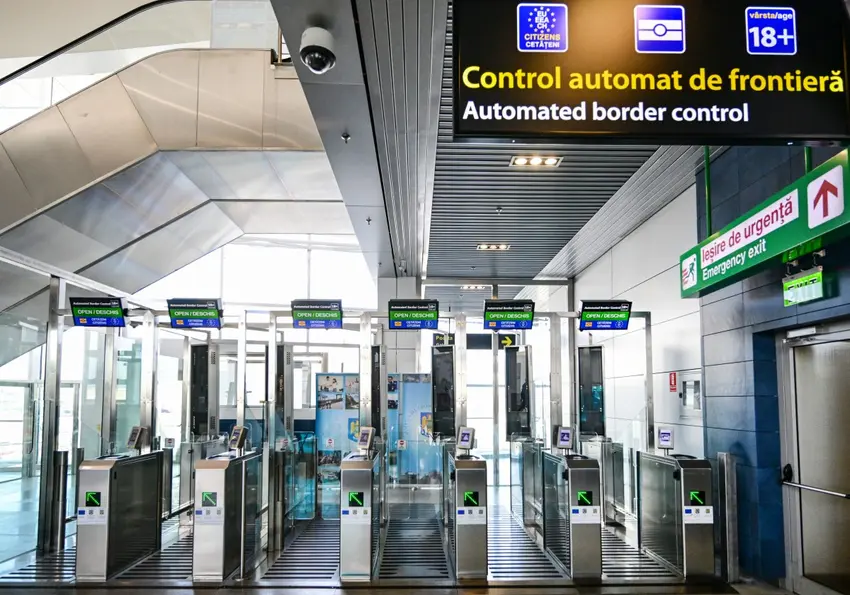
"It is a historic moment to finally welcome Bulgaria and Romania," said Interior Minister Sandor Pinter of Hungary, whose country holds the EU's rotating presidency.
Allowing Romania and Bulgaria to enter the Schengen Area fully as of January 1st, 2025, further expands “the world's largest common area without internal border controls.”
The decision ends over a decade of waiting for the two countries.
"This is a historic decision, marking the end of the process of accession of the two countries to the EU free movement area, a key objective of both Bulgaria and Romania since their accession to the European Union," the two countries said in a statement.
The European Commission, which evaluates whether the requirements to join are met, gave its green light to the two countries back in 2011. However, doubts persisted about governance and immigration issues among some EU member states.
After the Netherlands lifted its veto last year, Austria was the next country to oppose, and it had concerns about migration and border management.
In December 2023, the European Council agreed to a partial solution to the impasse, agreeing that Bulgaria and Romania would remove air and sea border checks with other Schengen countries on March 31st 2024, but maintain controls at land borders.
Since March 31st, the two countries have issued Schengen visas and applied the 90/180 rule for non-EU travellers. This means that visa-free short-term visitors' days spent in Bulgaria and Romania count towards the maximum stay across the Schengen area of 90 days in any 180-day period.
At the end of November, at a meeting in Budapest under the Hungarian Presidency of the EU Council, Hungary, Bulgaria, Romania, and Austria agreed on a “border protection package” which paved the way for the lifting of land border checks and for Bulgaria and Romania to become full members of the Schengen Area from January 1st, 2025.
READ ALSO: Austria backs Bulgaria and Romania's Schengen entry after years of delay
After the provisional approval by EU Ambassadors, Bálint Ódor, Permanent Representative of Hungary to the EU, called the decision “a milestone”. The decision was formally made at the EU Justice and Home Affairs Council meeting on December 12th.
More economic opportunities
The European Economic and Social Committee (EESC), a consultative body to the EU, said that “granting full Schengen status to Bulgaria and Romania will also benefit the EU single market, as any limitations on freedom of movement within the EU adversely affect EU competitiveness and hamper its economic growth.”
An Economic Research Institute of the Bulgarian Academy of Sciences (ERI) study says Bulgaria's partial accession to the Schengen Area caused annual losses of over €834 million. Delays at land borders in Romania are estimated to cost transport operators €90 million and an additional €2.32 billion in annual revenues, the EESC reported.
“Companies in the two countries pay billions of euros annually due to increased logistics costs, delays impacting deliveries of goods and equipment, and increasing fuel and driver wages. Higher prices pass these costs on to consumers. There are negative effects on the environment, tourism, and cross-border labour mobility, to name just a few,” said Mariya Mincheva, who led the preparation of the EESC opinion.
READ ALSO: What will EES passport system mean for foreigners living in Europe?
In a recent intervention at the European Parliament, Bulgarian MEP Kristian Vigenin said: “That Bulgaria and Romania have long fulfilled all the requirements to exercise effective control at their borders is well known. That it is time for the discriminatory treatment of the citizens of the two countries to end is also true. But Bulgaria and Romania fully in Schengen also means a significant reduction in the delivery time of goods and transport costs, strengthening the sustainability and competitiveness of European business.”
Digital border and travel authorisation
The full entry into the Schengen Area will also mean that Romania and Bulgaria will adopt the EU Entry/Exit System, the new digital border system that will be gradually introduced next year after several delays.
Travellers to Bulgaria and Romania from outside the EU who do not need a visa will also be required to have a travel authorisation (ETIAS), which will cost €7 when this is introduced.
Since joining the EU in 2007, the two countries have progressively accessed the EU home affairs and security databases, including the Schengen Information System. This allows border, immigration, police, customs and judicial authorities to consult EU-wide alerts on people and objects.
READ ALSO: OPINION: Europe's open borders are precious, but they are under threat
What is the Schengen Area
The Schengen area was introduced in 1985 in five countries (Belgium, France, Germany, Luxembourg, and the Netherlands) and has since expanded to include 29 countries (all EU member states minus Cyprus and Ireland, plus Iceland, Liechtenstein, Norway, and Switzerland).
With Romania and Bulgaria, the Schengen area covers 4.5 million square kilometres and a population of 450 million.
READ NEXT: How to prepare for travel under Europe's new EES and ETIAS rules
Comments